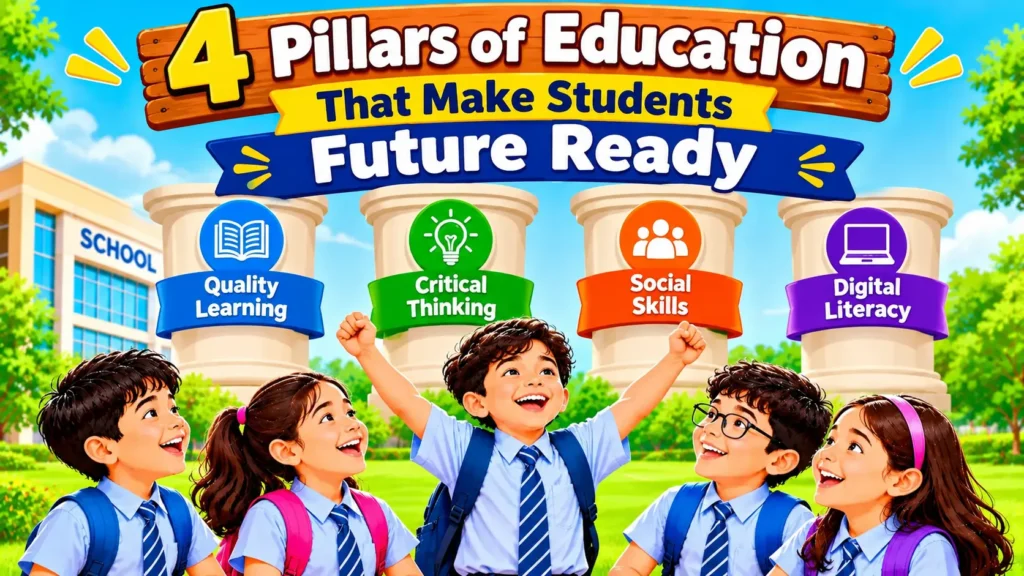
4 Pillars of Education That Make Students Future Ready
Education today is about more than memorising facts and passing examinations. Students also need to think independently, apply what they know, work with others and develop a sense of who they are. The four pillars of education, one of the most widely cited frameworks in education, describe exactly these four dimensions of learning: learning to know, learning to do, learning to live together and learning to be.
The framework comes from Learning: The Treasure Within, the 1996 report to UNESCO of the International Commission on Education for the Twenty-first Century, chaired by Jacques Delors. It remains a common reference point for teachers, school leaders and policymakers thinking about what education is for. This guide explains each pillar, why they matter and how parents and schools can apply them.
What Are the Four Pillars of Education?
The four pillars are a framework for holistic, lifelong education. Together they describe what a well-rounded education aims to develop:
- Learning to Know: understanding concepts and learning how to learn.
- Learning to Do: applying knowledge and developing competence for real situations.
- Learning to Live Together: understanding others and cooperating towards shared goals.
- Learning to Be: developing the whole person, including character, judgment and independence.
The Commission stressed that the pillars are not separate subjects. They support one another, and an education that neglects any one of them is incomplete.
1. Learning to Know: Developing Knowledge and Critical Thinking
The first pillar is about acquiring a broad base of knowledge and, just as importantly, learning how to learn. It combines general understanding with the chance to study some subjects in depth. It also covers habits that last beyond school: curiosity, concentration, memory, and the ability to find, evaluate and connect information.
In practice this looks like:
- Asking meaningful questions and following them up through reading or research.
- Classroom discussions that ask students to explain their reasoning.
- Experiments and observation, where students test ideas instead of just receiving them.
- Independent projects that connect more than one subject.
How parents and teachers can encourage it: Reward good questions, not just correct answers. Encourage regular reading. Ask “How do you know?” and “What else could explain this?” Give students time to explore topics they find interesting.
2. Learning to Do: Applying Knowledge Through Practical Skills
Learning to do asks a simple question: can a student use what they know? In the Delors Report it is framed as a move from narrow skill to broader competence. That means the ability to handle varied and unfamiliar situations and to work in teams, not just to perform a defined task.
It is not limited to vocational training, and it is not just “finishing tasks”. It is the effective application of knowledge in different contexts. This pillar typically involves:
- Problem-solving and decision-making: working through an unfamiliar problem and weighing options.
- Creativity and innovation: designing or building something new.
- Communication and collaboration: explaining ideas clearly and contributing to a shared result.
- Hands-on learning: practical work that turns concepts into experience.
Examples include science experiments, model-building, coding exercises, presentations, team projects and sport. A student who can explain the water cycle has learned to know. A student who builds a working model of it and explains its limits is also learning to do.
3. Learning to Live Together: Building Cooperation and Respect
This pillar addresses how students relate to others. The Commission highlighted two linked aims: discovering others, which means understanding their history, traditions and perspectives, and working towards common objectives, because cooperation is learned through shared tasks.
It develops:
- Understanding of different cultures and viewpoints.
- Empathy, and responsible behaviour towards others.
- Teamwork and communication.
- Conflict resolution and peaceful coexistence.
- A sense of social responsibility.
Group projects, structured classroom discussions, peer learning and community activities all provide opportunities. Values such as honesty, respect and fairness underpin the pillar; our guide to the Top 7 Most Effective Moral Values Every Student Must Learn looks at these in more detail.
4. Learning to Be: Supporting Holistic Personal Development
The fourth pillar concerns the development of the whole person: mind, body, sensitivity, aesthetic sense and personal responsibility. It builds on the earlier idea of learning to be in the 1972 UNESCO report by Edgar Faure and colleagues. It supports:
- Self-awareness and a sense of identity.
- Confidence and independence.
- Emotional development.
- Ethical values and a sense of responsibility.
- Creative expression and personal judgment.
- A sense of purpose.
Arts, sport, reflection and age-appropriate opportunities to make decisions all contribute. So do relationships with adults who give students guidance and room to think for themselves. Activities such as drama, music, yoga and team sport give students ways to express themselves and discover their strengths.
Why Are the Four Pillars of Education Important for Students?
Academic knowledge alone does not prepare students for work, relationships or change. Taken together, the four pillars support:
- Critical and independent thinking.
- Practical problem-solving.
- Communication and teamwork.
- Respect and empathy.
- Confidence and self-awareness.
- Adaptability and lifelong learning.
No framework guarantees these outcomes, and results depend on how consistently students experience these kinds of learning. But the pillars give parents and educators a clear checklist for balanced development.
How Can Schools and Parents Apply the Four Pillars of Education?
Schools can:
- Build inquiry into lessons, so students ask and investigate before being told.
- Provide regular chances to apply learning through labs, projects and presentations.
- Promote respectful discussion and structured teamwork.
- Make space for creativity, sport and individual expression.
Parents can:
- Encourage curiosity, reading and questions.
- Involve children in everyday problem-solving, such as planning a budget or fixing something at home.
- Model cooperation and respect, and teach it explicitly.
- Offer age-appropriate choices and let children live with their consequences.
- Support their interests, not only their marks.
How the Four Pillars Work Together
The pillars describe dimensions of one learning experience. Consider a group project on reducing water waste at school:
- Learning to know: students research how much water the school uses and why.
- Learning to do: they measure, build a simple prototype or draft a plan.
- Learning to live together: they divide tasks, resolve disagreements and listen to one another.
- Learning to be: each student takes responsibility for a part and presents their own view.
Remove any one element and the experience becomes thinner.
Frequently Asked Questions
What are the four pillars of education?
They are learning to know, learning to do, learning to live together and learning to be. Together they describe a holistic, lifelong approach to education that develops knowledge, practical competence, social understanding and personal growth.
Why are the four pillars of education important?
They remind schools and families that education should develop the whole person, not only exam performance. A balance across the four dimensions helps students think critically, apply knowledge, cooperate with others and understand themselves.
What does learning to do mean in the four pillars of education?
Learning to do means applying knowledge effectively in real situations. It goes beyond occupational training to include competence: solving problems, making decisions, communicating and working in teams.
Who introduced the four pillars of education?
They were set out in Learning: The Treasure Within, the 1996 report to UNESCO by the International Commission on Education for the Twenty-first Century, chaired by Jacques Delors. The idea of “learning to be” also draws on UNESCO’s earlier 1972 Faure Report.
Conclusion
The four pillars of education offer a balanced view of what learning should achieve: knowledge, practical competence, cooperation and personal development. They work as a set, and the strongest learning experiences draw on all four.
In practice, schools express these ideas in different ways. SKS World School follows the CBSE curriculum from Pre-Nursery to Class XII. Its published philosophy sets out a six-part learning framework (know, think, apply, reflect, care and lead) and a values-based approach, which you can read in its educational philosophy. Its beyond-curriculum programme lists a robotics lab run in association with LEGO, drama and music sessions, yoga, self-defence classes and sports. As with any school, parents are best placed to judge this by visiting and asking how learning is organised day to day.
