
ICSE vs CBSE: Which Board Is Better for Your Child in 2027?
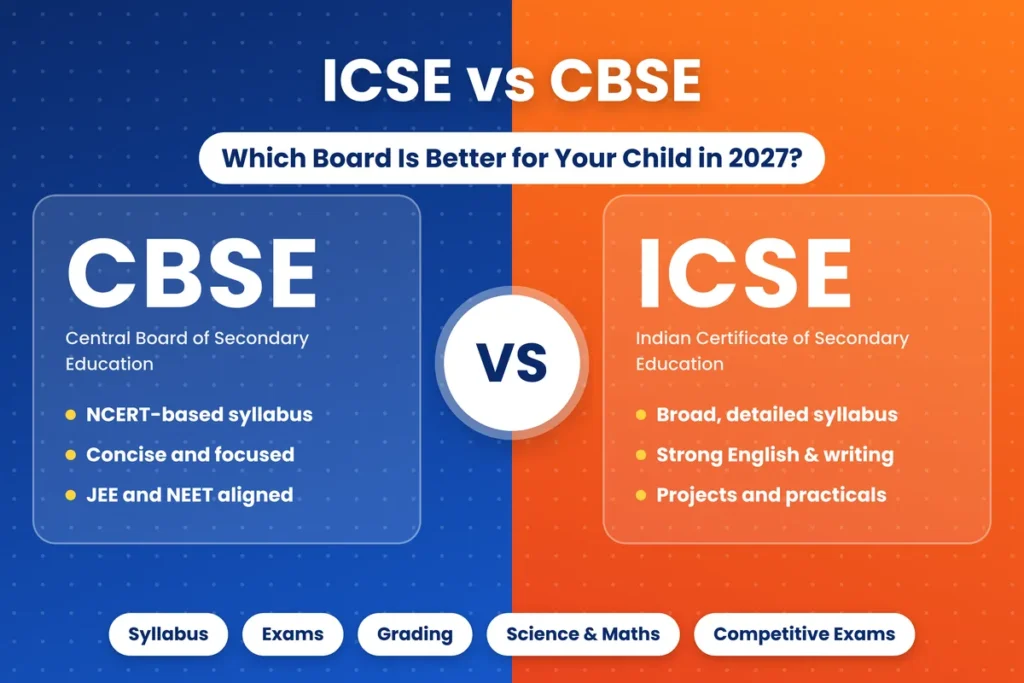
Choosing the right education board is a crucial decision for every parent. The ICSE vs CBSE comparison often raises questions about which curriculum offers better learning opportunities, academic development, and future prospects.
Both boards have different curriculum structures, teaching approaches, and assessment methods. While CBSE is known for its structured curriculum and alignment with national entrance examination preparation, ICSE offers broader subject coverage with a strong emphasis on English language and written communication.
So, which board is better for your child in 2027? Let’s explore their key differences to help you make an informed decision.
What Is the CBSE Board?
The Central Board of Secondary Education (CBSE) is India’s national school board, run under the Government of India. It is the most widely adopted board in the country, including in Kendriya Vidyalayas and many private schools.
- Follows NCERT textbooks, with a focused, concept-based syllabus
- Strong presence across India and in many schools abroad
- Exams are held for Class 10 and Class 12
- Subjects are streamlined, with Science, Maths, and Social Science as core subjects
What Is the ICSE Board?
The Indian Certificate of Secondary Education (ICSE) is run by the Council for the Indian School Certificate Examinations (CISCE), a private, non-governmental board. ICSE covers Class 10, while its Class 12 version is called ISC.
- Detailed syllabus with stronger emphasis on English language and literature
- Wide subject choice, including arts and humanities, alongside Science and Maths
- Greater weight on projects, practical work, and internal assessment
- Uses its own syllabus with private-publisher textbooks, not NCERT
ICSE vs CBSE: Key Differences at a Glance
| Feature | CBSE | ICSE |
| Governing body | Government of India | CISCE (private council) |
| Syllabus style | Concise, concept-focused | Broad, detailed, application-based |
| Textbooks | NCERT | Private publishers |
| English emphasis | Moderate | Strong |
| Subject choice | Structured, simpler | Wider, more flexible |
| Internal assessment | Present | Higher weight in projects |
| Availability | Very wide, pan-India | Fewer schools |
| Competitive exam alignment | Close (NCERT-based) | Needs extra alignment |
| Typical school fees | Often lower | Often higher |
Difference Between CBSE and ICSE Syllabus
CBSE keeps its syllabus concise, built around NCERT books and core concepts. ICSE goes wider, with more topics, more reading and a stronger writing component.
Here is what that means for your child:
- CBSE: fewer topics, clear textbook focus, easier to revise
- ICSE: more content, more depth, more writing practice
- Languages: ICSE puts extra weight on English literature
ICSE vs CBSE: Which Board Has a More Difficult Syllabus?
ICSE is generally seen as the more demanding board because of its breadth, but difficulty depends on your child. A child who enjoys reading and detailed study may thrive in ICSE, while one who prefers focused, concept-based learning may find CBSE more comfortable.
- ICSE has more content to learn and more writing in exams
- CBSE questions have shifted toward concepts and competency, which tests understanding more than memory
- “Easier” often depends on teaching quality and school support, not just the board
Difference Between CBSE and ICSE Exams and Grading
Exam Pattern – CBSE papers mix objective and subjective questions, and more of them are now case-based and competency-based. ICSE papers lean towards detailed written answers, with strong marks for clarity and language.
Internal Assessment – Both boards include internal assessment such as projects and practicals. The weightage differs by subject, so check each board’s current scheme.
Grading and Passing – Both boards report marks and grades, but the schemes differ and can change. In CBSE, students need at least 33% in each subject to pass.
The 2027 CBSE board exams begin on February 16, 2027, and ICSE dates are expected in February-March 2027, so check cbse.gov.in and cisce.org for the final schedule.
CBSE vs ICSE: Which Is Better for Science and Mathematics?
Both boards teach strong science and maths, with different strengths. CBSE builds clear fundamentals through NCERT, while ICSE adds depth, more problems, and a wider range of topics.
- CBSE: Concept clarity and a direct link to entrance exam syllabus
- ICSE: More depth and problem-solving, helpful for analytical thinkers
- Class 9 update: CBSE is introducing two levels of maths and science starting with students who entered Class 9 in 2026-27, with the first exam impact in 2028
ICSE vs CBSE: Which Is Better for Competitive Exams?
CBSE has a natural advantage for entrance exams like JEE and NEET, as NCERT forms the base of their preparation. ICSE students can also succeed, particularly because of strong English and depth, but they usually need to align with NCERT during preparation.
- CBSE: Direct fit with NCERT-based exam preparation and coaching material
- ICSE: Strong foundation, but plan extra NCERT study in Classes 9-12
- In both: A child’s consistency, teaching quality, and coaching matter more than the board
Advantages and Disadvantages of CBSE Board
| Advantages | Disadvantages |
| Wide availability across India | Less depth than ICSE in some subjects |
| NCERT books are affordable and easy to find | Less emphasis on English literature |
| Close fit with JEE, NEET, and CUET prep | Fewer subject combinations in some schools |
| Easier transfer between cities | Rote learning can still creep in at some schools |
| Generally lower fees |
Advantages and Disadvantages of ICSE Board
| Advantages | Disadvantages |
| Strong English and communication skills | Heavy syllabus and workload |
| Broad subject choice and balanced learning | Fewer schools, especially in smaller cities |
| Project and application-based learning | Needs extra effort for competitive exam alignment |
| Well recognised in India and abroad | Fees are usually higher |
Factors Parents Should Consider Before Choosing
Ask these questions first, whether you are comparing CBSE and ICSE schools or looking within one board:
- Your child’s learning style: does your child prefer concise concepts or detailed reading and writing?
- Career goals: engineering, medicine, and civil services often lean towards CBSE-aligned preparation
- Family mobility: CBSE schools are easier to find if you may relocate
- School nearby: a good school close to home beats a better board far away
- Budget: compare the full yearly cost, not just tuition
Write your answers down for each factor, then compare them with the table above. A clear pattern usually appears, and it makes the choice much easier.
ICSE vs CBSE: Which Board Is Better for Your Child in 2027?
There is no single winner, so match the board to the child.
Choose CBSE if:
- You want alignment with JEE, NEET, or CUET
- Your family may relocate within India
- You prefer a focused, concept-based syllabus
Choose ICSE if:
- Your child enjoys reading, writing, and detailed study
- Strong English and all-round development are priorities
- You are comfortable with a heavier workload and higher fees
For children entering Class 6 or Class 9 now, remember that CBSE is rolling out curriculum changes, so ask schools how they are preparing.
Frequently Asked Questions
1. Which board is better, ICSE or CBSE?
Neither is universally better. CBSE suits families wanting a focused, NCERT-based syllabus and alignment with entrance exams, while ICSE suits children who enjoy depth, English, and project work.
2. Should I put my child in CBSE or ICSE?
Choose CBSE if you want entrance exam alignment or may relocate often. Choose ICSE if your child enjoys detailed study and strong English, and you are comfortable with a heavier workload.
3. Which is the hardest, ICSE or CBSE?
ICSE is generally seen as harder because of its wider syllabus and more writing, but difficulty depends on the child and the school.
4. Can a CBSE student go to ICSE?
Yes, students can switch boards, subject to school admission and syllabus gaps. It is easiest in the early classes, and harder in Classes 9-10 because of board exam preparation.
5. Is ICSE more expensive than CBSE?
ICSE schools often charge higher fees, but fees depend mostly on the school, its facilities, and its location rather than the board.
6. Is it easy to score 90% in ICSE?
It is achievable but not easy. It needs consistent effort, strong writing skills, and good project work, and scoring varies by subject and school.
7. Is 70% good in CBSE?
It is generally considered a solid score. Whether it is enough depends on your goals, since some courses and colleges have higher cutoffs.
8. Does ICSE also use NCERT?
No, ICSE follows its own syllabus with private-publisher textbooks. ICSE students aiming for NCERT-based entrance exams usually study NCERT separately.
9. Which board is best for kids?
The best board is the one that suits your child’s learning style, interests, and your family’s plans. A good school and teachers matter as much as the board.
10. Why do parents prefer CBSE schools?
CBSE schools are widely available, easy to transfer between, usually more affordable, and closely aligned with national entrance exams like JEE and NEET.
Conclusion
Choosing between ICSE vs CBSE is less about which board is “better” and more about which one fits your child’s strengths, your career goals, and your family’s plans. Look at the child first, then the board, and then the school.
SKS World School, Best School in Noida, supports parents with clear guidance on curriculum, learning approach, and admissions, and focuses on all-round development so that every child grows with confidence.
